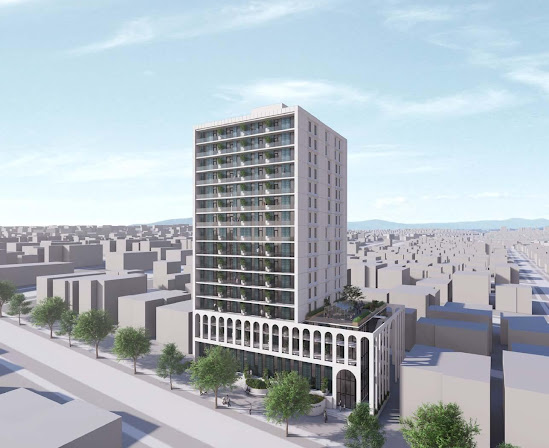
Last week I had a call from Globe and Mail journalist Kerry Gold who asked whether I had any thoughts on the appropriateness of highrise apartments for families with children. Did I ever! For years I have been thinking about this since my days at CMHC when we generally designed highrises for seniors but tried to accommodate families with children in townhouses, or low and midrise apartments generally not highter than the sixth or seventh floor. That is because social planners reminded us that parents wanted to be able to see their children playing outside and call out to them when necessary.
At CMHC, I also learned about the importance of building and suite designs for families with younger children. Exterior corridors were often preferable to long, interior corridors where children would run up and down and disturb other residents. In addition to outdoor play areas that had to be located where the kids were visible to the maximum number of homes, there should be interior play areas as well, if at all possible. We also needed to think about places to store strollers, prams, etc.
The suite design also needed modifications. While many people might be happy eating on a stool around an island, younger children really benefitted from an eating area in the kitchen with table and chairs. This was particularly true in the days when carpeting was the most common flooring in the dining and living area. For more information about designing apartments for kids, I suggested that Kerry check out a 1992 City of Vancouver publication 'Housing families at higher densities' which we used when designing Bayshore.
https://beasleyassociates.files.wordpress.com/2023/02/cityofvancouver.housingfamiliesat-highdensity.guidelines.1992.pdf
Although to be honest, we did not expect many kids to live at Bayshore since there was no nearby school. That's why we designed the play area as a 'sandbox' with a wooden boat replica, to look like a piece of art. You can find it in front of 1717 Bayshore Drive.
While some say we just need government to mandate a requirement for more two and three bedroom suites, that in itself is not the answer. Why do I say this? Well check out this new 3-bedroom apartment. Can you imagine a family with three kids living there? For that matter, can you imagine any household living there? Just look at the size of the kitchen!
Yesterday, Kerry's excellent article appeared and generated considerable discussion. I was pleased to do a short follow-up interview with CKNW's Jas Johal who was interested in better understanding some of the comments I made in the article which you will find below. I hope this conversation continues.
With Metro Vancouver projected to add another one
million people in 17 years, it’s no wonder that the province has unrolled so
much legislation aimed at increasing density, particularly around transit.
If the projection is accurate, four million people
will live in the region, and many of them will have kids. That makes high-rise
living for families an essential part of the housing picture. However, we have
a long way to go, Simon Fraser University City Program director Andy Yan says.
He found that only 15 per cent of Vancouver
children under the age of 14 are living in multifamily buildings that are more
than five storeys, either owned or rented, according to census numbers for
2021. In Burnaby, home to a lot of skyscrapers, only 17 per cent of kids live
in these units. In Surrey, it’s 2 per cent. Region-wide, it’s 8 per cent of
kids. In Toronto, by contrast, 35 per cent of children live in multifamily
buildings.
Part of the problem for the Vancouver region,
developer and real estate consultant Michael Geller says, is the drive for
developers to sell enough units to qualify for financing, and in B.C. they
typically only have a year to do so. With that kind of pressure, they cater to
the investor who’s looking for studios and one-bedrooms to rent out, which is
why two- and three-bedroom family units are often an afterthought unless there
is government policy in place requiring a certain percentage of family units.
He recalls recently arguing with a high-profile marketer who was pushing for
small investor apartments in a project that didn’t even need to qualify for
financing. But that is the Vancouver way.
“Other than government-funded projects and
non-profit projects, it’s very rare that a market developer would develop or
design a market condo or even rental project for families with children,” says
Mr. Geller, who recently spoke on a panel about the reasons family housing
doesn’t get built. “I know that most of the two-bedrooms we provide, we provide
them because it’s an obligation, but rarely do we design those suites thinking
there may be a toddler living in that unit.
“One reason is because, if it’s a new building, so
much of the development program is based on what you can presell because if you
can’t presell enough units, you won’t get your financing. And you might ask,
why would the investors buy them? One reason is that the building might not be
finished for four years, and most families are not in a position to buy
something today that won’t be completed for four years.”
Mr. Geller started his career working for Canada
Mortgage and Housing Corp., and he did a lot of social housing.
“In social housing projects, funded by CMHC, we
were really designing for families with children, or empty nesters, rather than
investors.”
As well, developers of dense buildings generally
don’t put a lot of thought into family amenities, he adds. Play areas for
children are kept off to the side and out of sight if they exist at all. Eating
areas often involve sitting on stools at a kitchen counter, and there is little
storage area for strollers and toys. “In Vancouver, the development of housing
has always been about form following financing,” Mr. Yan says. “The needs of
children should take precedence over granite countertops and walk-in closets.
And it’s not just about affordability, but also size, design and amenities.”
There are signs, however, that developers are
properly stepping into the family-friendly space, especially rental. Because of
interest rates, the condo market isn’t as financially viable as it has been in
previous years, so many developers are pivoting to rental, which is in demand.
Government policies have helped, including the federal break on GST for rental
construction. He cites census data that show renter households grew by 21.5 per
cent by 2021, compared with owner households, which only grew by 8.4 per cent.

Developer Brent Sawchyn of PC Urban Properties says the project will include B.C.’s first 24-hour daycare.PC URBAN PROPERTIES
Developer Brent Sawchyn is proposing B.C.’s first
24-hour daycare for his site at West 13th Avenue and Willow Street, across from
Vancouver General Hospital. It will serve hospital staff who work the night
shift, and will be part of a two-tower, 354-unit purpose-built rental
development that will include large indoor and outdoor play areas. The site is
currently duplexes that they assembled and purchased, so it won’t involve
displacement of renters. Mr. Sawchyn says his company is not looking at older rental
buildings in the Broadway Plan area because of the complexity of the city’s
tenant relocation and protection policy and because of “sensitivities” around
displacing existing renters.
His Willow Street project is responding to the
Broadway Plan requirement for a minimum 35 per cent of two or more bedrooms in
market rental housing. The plan requires three-bedroom units “wherever
possible.” In social housing projects suitable to families, the target is
50-per-cent two- and three-bedroom units.
“It’s an example of how the industry is trying to
respond to what the needs will be,” says Mr. Sawchyn, who submitted a rezoning
application for the project, at 816-860 W. 13th Ave. and 2915-2925 Willow St.
“It’s a different paradigm that we are looking at,”
he adds. “I think maybe the luxury of opening the back door and letting your
kid play in a backyard in a set surrounding is not going to be attainable for a
lot of people going forward.
“Here in Vancouver the universe of single-family
homes is essentially diminishing,” he says. “In various cohort groups people
have decided to give up on home ownership and have decided to just focus on
rental as a way of housing for their future.”
His company, PC Urban Properties, has about 900
apartment units under construction and another 1,100 proposed for Vancouver.
Their focus is the Lower Mainland, but they also have projects in Victoria and
Kelowna.
The site is currently duplexes that the developer assembled and
purchased, so it won’t involve displacement of renters.PC URBAN PROPERTIES
“As we go forward, we probably need to be more
cognizant in developing more of these projects to accommodate families.”
But there are challenges, including policies that
he says overcomplicate the delivery of housing. He cites the example of his
Kerrisdale site where they benefited from the federal government’s removal of
GST on rental housing, which saved almost $10-million. But the Metro Vancouver
and city fees amounted to $12-million. It takes about 15 or more months to get
to a public hearing and another year to get the development permit.
“The costs that go into a rental project,
unfortunately, find their way to what a tenant has to pay in rent, and the
larger the apartment home, unfortunately, the more the rent is going to be.”
Downtown rentals are at around $6 per square foot
in the new projects, or $3,000 for a 500-square-foot apartment.
Like many, he says a big part of the problem is
that the federal government stopped building subsidized housing for families
decades ago.
“The federal government abdicated their
responsibility. Now the older stock by default has become our affordable supply
because we haven’t built housing since the 1980s.”
Affordability is a continuing problem, but in the
meantime, developers can step up amenities to attract families. Concert
Properties just launched a lending library at its East Vancouver 28-acre
Collingwood Village development, where residents can now borrow kitchen
appliances, tools and sports gear as part of a partnership with a lending
library company called the Thingery. The five-building complex has 704 rental
units and has focused on family amenities such as play areas and tennis and
basketball courts. The new lending library saves families money and reduces
waste, Grant Knowles, Concert Properties vice-president of property management,
says in an e-mail.
“There is a growing need to build communities and residential areas that
can support families,” Mr. Knowles says.
Postscript: Kerry advises me that she did include the following that unfortunately had to be cut due to space limitations.
Mr. Geller suggests that designing for families could include special attention paid to the first five storeys of the building, which are most suitable to families who want to be near ground level, and the play areas. Although it’s seldom a design feature, developers could design buildings with exterior corridors that are sheltered from the weather, areas where kids could play. Municipalities could allow enclosed balconies for extra play space.
He says the province’s recent announcement to possibly relax requirements that every building has two exit stairwells will help reconfigure apartment living into a much more pleasant, spacious, brighter experience—similar to European apartment living. The two-stairwell rule for apartment buildings has meant apartment units are off long dark corridors, whereas a single-stairwell building can have a bright central staircase and an elevator.
That design change could also offer increased exchanges with one’s neighbours, which is key for a lot of families. It’s also easier to build single-stairwell buildings on smaller lots, where floor plate size is restricted.
“It’s much more important for families with children to know your neighbours than it is for 20-something singles living downtown,” he says. “It’s a reality that families with children tend to depend on one another much more. You want your children to play together or encourage them to play together.”